Explaining the LightGBM Champion Model
This report provides a deep dive into our champion model, LightGBM, which was chosen after a rigorous process of evaluation and refinement, as detailed in the Model Selection Report. Here, we use SHAP to understand why the model makes its decisions.
1. Executive Summary
After identifying and correcting an overfitting issue caused by a leaky feature, the final LightGBM model was validated as the champion. It achieves a Test Set RMSE of $7.60 and demonstrates stable, reliable, and interpretable behavior.
This SHAP analysis confirms that the model has learned logical and robust patterns from the data. Key drivers of price predictions include time, flight_type, and now, critically, temporal features like day_of_week and day. The model's behavior is consistent, and its predictions can be trusted.
2. Global Model Explainability
A. SHAP Summary Plot
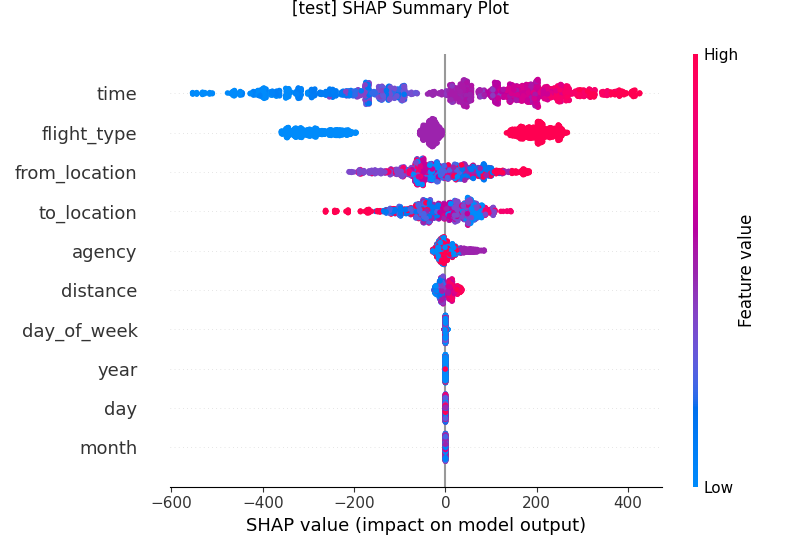
The summary plot provides a global overview of the model's feature importance and the impact of each feature on the predictions.
Insights:
timeremains the most influential feature. Higher values (longer flights) strongly push the price prediction higher.flight_typeis the second most important feature, with a clear categorical impact.- Temporal Features Matter: Unlike previous iterations,
day_of_weekanddayare now contributing which confirms that removing the complex feature engineering process has allowed the model to learn these more subtle patterns. This gets more clear in local shap analysis.
B. SHAP Feature Importance (Bar Plot)
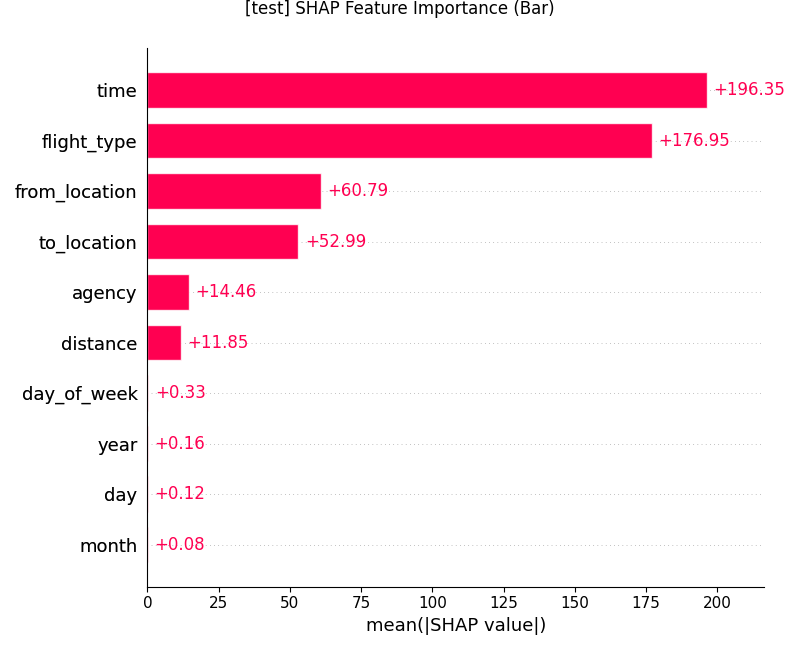
This plot shows the mean absolute SHAP value for each feature, quantifying its average impact on the model's output.
Insights:
- This plot confirms the findings from the summary plot, with
time,flight_type,from_location,to_location, and being the top features. - The feature importance is now more distributed and logical, without a single feature dominating the model's decisions.
- Temporal Features also have some level of importance which closely aligns with the exploratory data analysis findings.
3. The Case of the Reappearing Temporal Features
In our initial, overfit models, temporal features like month, year, day and day_of_week were assigned zero importance. This was a major red flag, as EDA showed clear seasonal patterns. The final, stable model corrects this.
Why did this happen?
The engineered features and preprocessing like scaling, OHE were causing model to focus more on some of the features that hold most of the predictive power . It was so powerful and specific that the model could essentially memorize the price for a given route, ignoring all other features. By overfitting to route, the model never needed to learn the more subtle (but more generalizable) patterns related to seasonality or the day of the week.
By removing the unnecessary preprocessing and features including route feature(removed in second interation), we forced the model to look for other signals. As a result, it correctly identified the importance of the cyclical day_of_week and day features, which now play a significant role in its predictions. This is a strong indicator that our final model is more robust and has learned a more accurate representation of the real-world factors driving flight prices.
4. Local Model Explainability
A. SHAP Force Plot
The force plot visualizes the SHAP values for individual predictions. The interactive plot linked below allows for exploring the forces driving the price for thousands of different flights.
View the interactive force plot
- It further shows the combinational power of the feature like lower
timeduration for flight andeconomyflight type reduced the price significantly. - Longer duration flights costs more when combined with expensive flight type like
firstclassand expensiveagencybut also show medium price when Longer duration is combined witheconomy.
B. SHAP Waterfall Plots
These plots show how the model arrived at its final prediction for specific instances. The f(x) value at the top is the model's predicted output, and E[f(x)] at the bottom is the base value (the average prediction).
The data for these instances can be found in the accompanying CSV file: Final_model_shap_local_instances.csv.
Instance 0
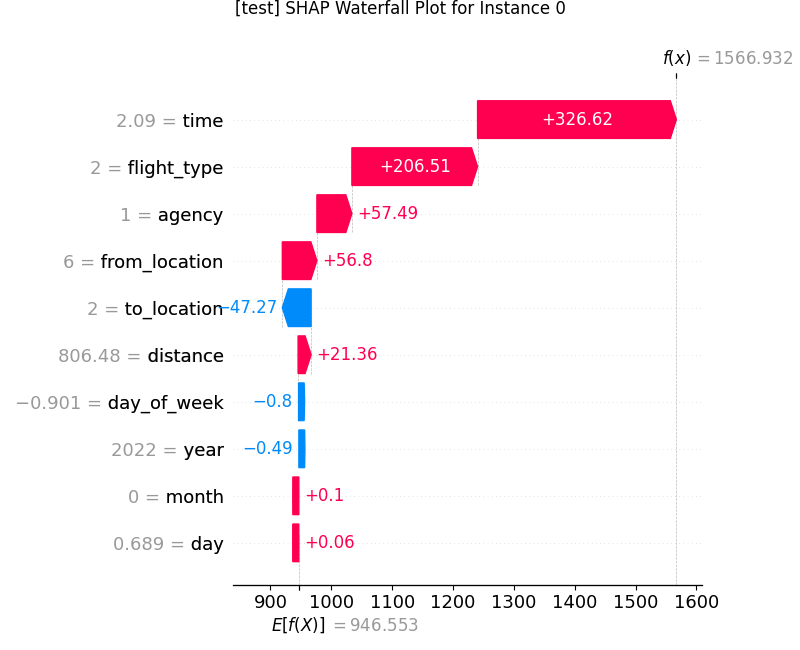
- Insights: The model correctly predicts a high price. The primary drivers are the long flight
timeand theflight_type(first class). The specificday_of_weekalso contributes positively to the price, demonstrating the model's use of temporal features. agencyalso contributes here some agencies are more expensive than others which aligns with the findings during EDA.
Instance 1
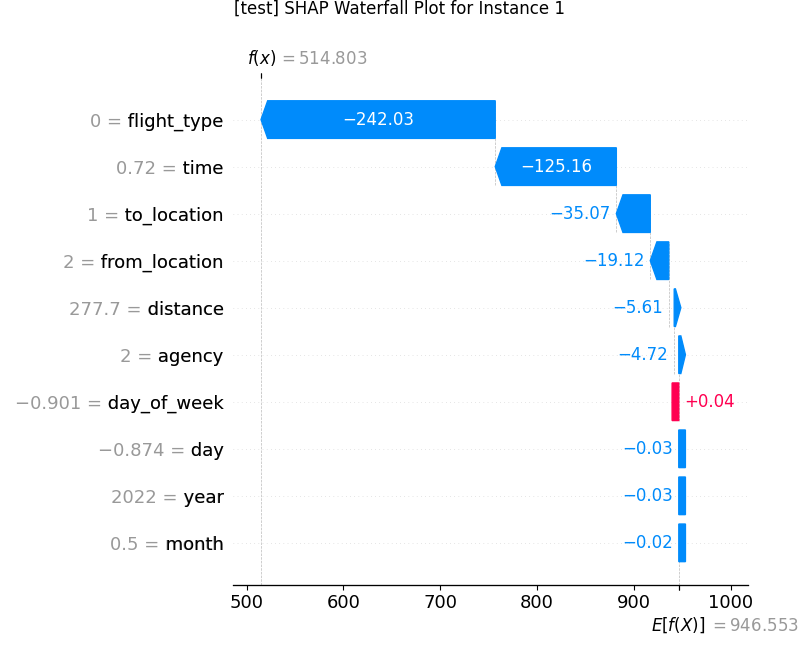
- Insight: The model predicts a low price significantly lower than the average, driven down by the
flight_type(economy) and a shorttime. Thefrom_location,to_locationincluding other features all contribute to lowering the price except for day_of_week which is increasing the price a little.
Instance 2
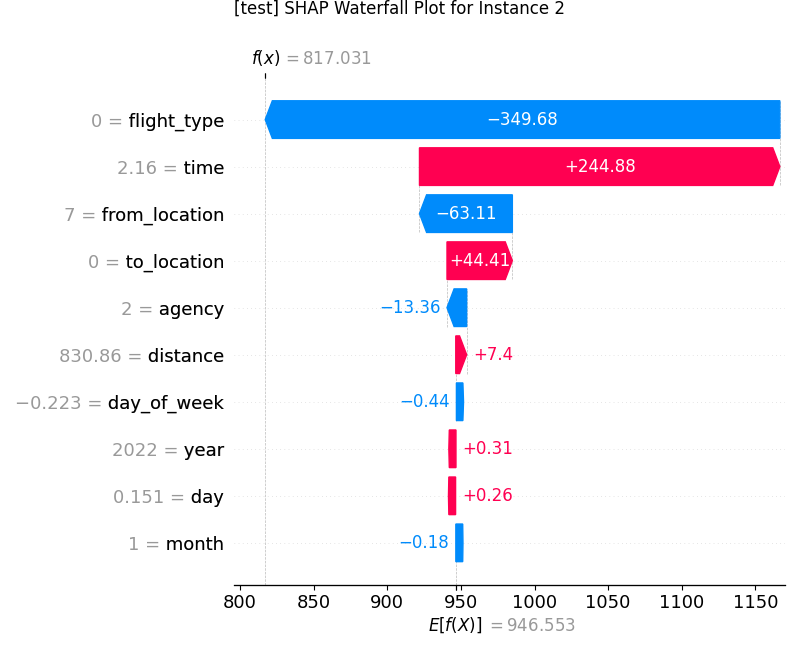
- Insight: Here, the model balances competing factors. A long
timepushes the price up, but this is counteracted by theflight_type(economy), cheaperagencyandfrom_location, a low-impactday_of_week, resulting in a prediction close to the average.
5. Feature Dependence Plots
Dependence plots show how a single feature's value affects its SHAP value, revealing the relationship it has learned.
A. Time
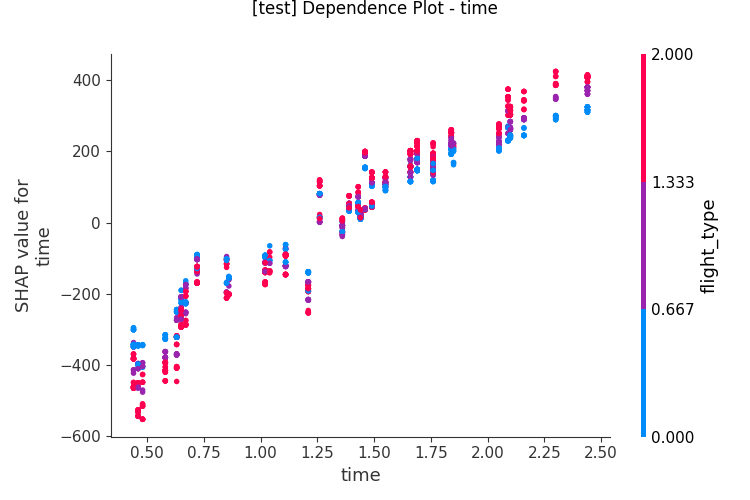
Insight: A clear, positive linear relationship. As flight duration increases, its impact on the price increases. The vertical coloring shows interactions with flight_type.
B. Day of Week
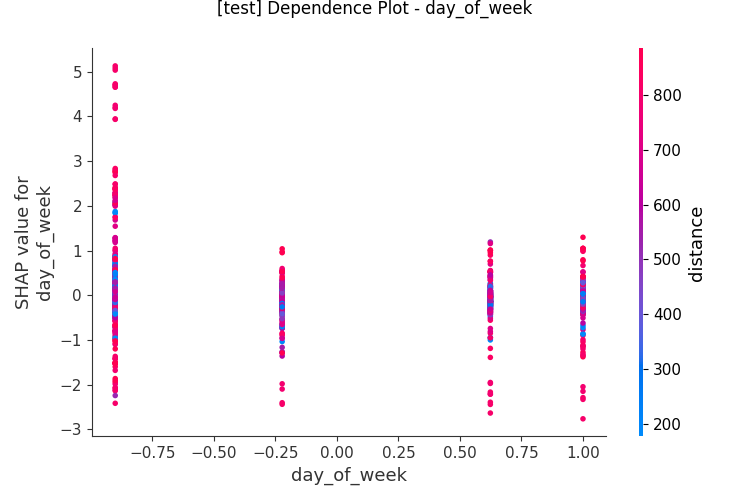
Insight: This plot is crucial. It shows the model has learned a distinct, non-linear pattern for the day of the week, confirming that the cyclical features are working as intended.
C. Flight Type
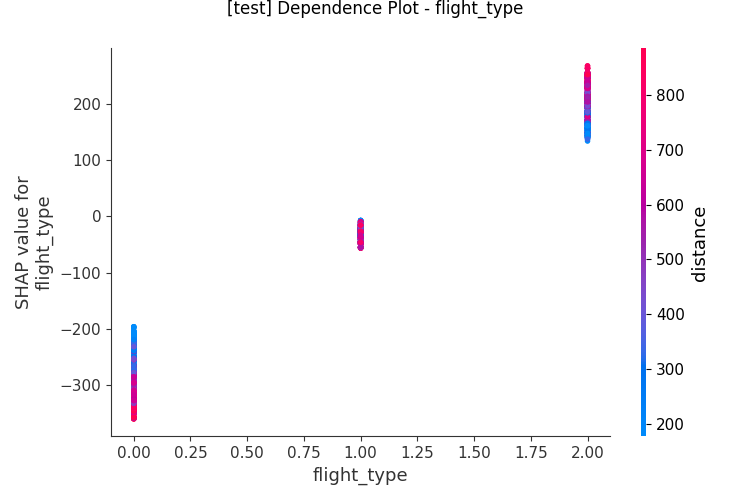
Insight: Shows the clear categorical impact of flight_type, with each class having a distinct and separate impact on price.
6. Conclusion
The SHAP analysis confirms that our final, stable LightGBM model is not a "black box". It has learned intuitive and explainable patterns from the data. Its predictions are driven by a logical hierarchy of features, and its behavior is consistent and trustworthy. This transparency is crucial for deploying the model in a production environment.